

As an affiliate, we may earn a commission from qualifying purchases. We get commissions for purchases made through links on this website from Amazon and other third parties.
An organic crib mattress protector should do three practical jobs: fit the exact mattress smoothly, block routine leaks, and survive the laundry process its label allows. Organic cotton can improve the surface feel, but most waterproof designs still use a separate membrane. These two options have clear standard-crib dimensions and enough product-specific evidence to compare without treating an organic label as a safety guarantee.
Best Thin Organic Pick
Best Fully Certified Layers
Our Organic Crib Mattress Protector Picks
1 / 2
Naturepedic Organic Waterproof Crib Mattress Pad
Fit
About 27.25 x 51.625 x 6 inches
Cotton
GOTS-certified organic top and bottom
Barrier
DrySleep waterproof membrane
Care
Machine wash and dry
Feel
Thin and fitted
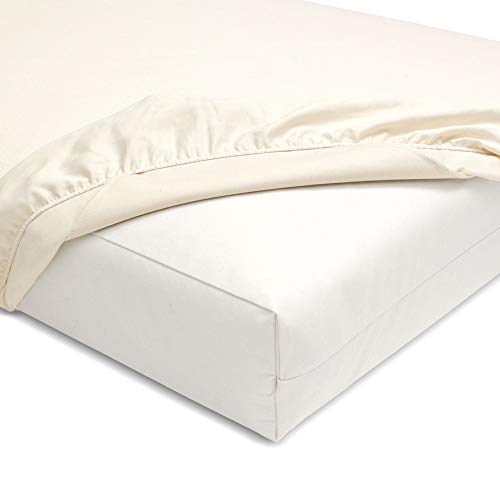
Naturepedic sandwiches a thin waterproof membrane between GOTS-certified organic cotton layers. Its stated fit is approximately 27.25 by 51.625 inches on a mattress up to 6 inches deep, giving buyers a concrete size to compare with their crib mattress instead of relying on a broad “standard” label.
Product-specific feedback supports the useful everyday details: owners describe a snug fit, a quiet feel, reliable leak protection, and easy washing. The construction is closer to a slim fitted protector than a plush quilted pad, so it is the stronger choice when you want minimal added bulk. That thinness can surprise buyers expecting obvious cushioning; it is protection, not an extra comfort layer.
Why It Works
- Organic cotton is used above and below the waterproof membrane.
- The defined 6-inch fit makes the final setup easier to check.
- Machine washing and drying support quick rotation after accidents.
- Owners report that sheets can fit smoothly over the protector.
What To Keep In Mind
- The slim construction may not match expectations for a padded product.
- Confirm that the selected version is the fitted standard-crib size.
- Follow the care label so heat does not shorten the barrier's life.
2 / 2
KATU Organic Cotton Crib Mattress Protector

Fit
Up to 52 x 28 x 6 inches
Cotton
GOTS-certified organic top and bottom
Barrier
Plant-based TPU
Care
Machine washable and dryer-friendly
Design
Full elastic perimeter
KATU uses GOTS-certified organic cotton on both outer layers and describes its plant-based TPU waterproof core as GOTS approved. The full elastic perimeter is sized for standard crib and toddler mattresses up to 52 by 28 by 6 inches, with extra allowance intended to settle after the first wash.
The clean product-specific feedback describes soft fabric, low noise, a snug fit, and good shape retention through repeated wash cycles. It also supports practical leak resistance without a stiff plastic feel. Wash it before first use as directed, then verify that the elastic is fully underneath the mattress and that no fabric shifts or bunches on top.
Why It Works
- Certification language covers both cotton layers and the approved barrier.
- The standard 52-by-28-inch dimensions and 6-inch depth are explicit.
- Owners report a quiet surface and a fit that stays put.
- Machine washing and dryer-compatible care simplify reuse.
What To Keep In Mind
- Its prewash sizing means the first fit is not the final fit.
- A waterproof TPU layer remains part of the construction despite the organic cotton.
- Inspect the fit again after every wash-and-dry cycle.
Quick Comparison
| Protector | Stated fit | Cotton construction | Waterproof layer | Care |
|---|---|---|---|---|
| Naturepedic | About 27.25 x 51.625 x 6 inches | GOTS-certified organic top and bottom | Thin DrySleep membrane | Machine wash and dry |
| KATU | Up to 52 x 28 x 6 inches | GOTS-certified organic top and bottom | Plant-based TPU | Machine wash; dryer-friendly |
How to Choose an Organic Crib Mattress Protector
Start with dimensions, not material claims. Measure the mattress length, width, and depth, then compare those numbers with the selected protector variant. The elastic should wrap fully under the mattress without lifting a corner. Use the crib mattress protector fit guide to check for wrinkles, shifting, or bunching before adding the fitted sheet.
Next, decide whether you need a thin protector or an absorbent quilted pad. A thin design usually dries faster and adds less bulk, while quilting may hold more liquid before it reaches the barrier. The crib mattress pad versus protector guide explains the difference without assuming every listing uses those terms consistently.
Read the whole material stack
“Organic” often describes the cotton surface, not every component. Waterproof protection usually depends on a synthetic or plant-derived membrane, and elastic or side skirts may use other fibers. Our protector materials guide can help you compare cotton, fill, backing, and barrier claims separately.
Certification scope matters too. Check whether a standard applies to the finished product, a textile layer, or a specific ingredient. If your priority is the broader mattress setup, compare the distinction between an organic crib mattress and an organic protector.
If low-emission claims are also part of your shortlist, keep them separate from fiber sourcing and use the crib product certification guide to compare what each label actually covers.
Match waterproofing to the laundry routine
A protector is only useful when it is clean, dry, and lying flat. Follow the labeled water temperature and drying instructions because excess heat can damage some membranes and elastic. The crib protector washing guide covers routine cleaning and inspection.
Keep a second protector only if both layers can be used separately and each setup remains smooth. The protector quantity guide helps plan overnight changes without stacking protectors for extra padding.
Keep the Finished Surface Firm and Flat
Place one compatible protector beneath one tight fitted sheet unless the crib or mattress maker says otherwise. Do not add a protector to change mattress firmness or fill a gap. Review whether a crib mattress protector is needed alongside the mattress warranty and care instructions.
After installation, press across the surface and edges. Remove any protector that causes ripples, lifted corners, loose fabric, or a sheet that cannot stay secured. Material and waterproof claims never override the controlling crib and mattress instructions.
Frequently Asked Questions
Is an organic crib mattress protector completely organic?
Not necessarily. Organic cotton may cover the sleeping surface while the waterproof membrane, elastic, fill, or skirt uses other materials. Read the complete fiber and layer description.
Does organic cotton make a protector waterproof?
No. Cotton absorbs moisture; a separate membrane normally creates the waterproof barrier.
Should I wash an organic protector before first use?
Follow the product label. KATU specifically directs buyers to wash before use so its intentionally larger initial sizing settles to the intended fit.
Can an organic protector make a crib mattress softer?
It should not be used to add cushioning. Choose a thin, compatible protector that keeps the finished surface firm, flat, and snug.
How do I know whether the protector fits correctly?
The elastic should stay under the mattress, the top should be smooth, and the fitted sheet should secure without lifting or bunching.
How often should I replace a waterproof crib protector?
Replace it when the membrane peels, cracks, leaks, or no longer lies flat, or when the elastic cannot hold a secure fit.
